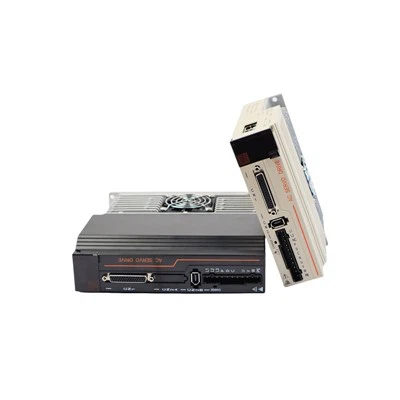
Tonghang specializes in high-performance linear servo drives/amplifiers and offers custom servo drives and services tailored to individual applications.
Tonghang's servo drive series is one of the highest-performing linear servo drive brands on the market today. Designed for low noise, wide bandwidth, and zero distortion at current zero crossings, the servo drives are available in continuous power ranges of 200W, 400W, 500W, 800W, and 1500W, with a maximum peak power of 6000W.
Advantages of our servo drives
★Safe Operating Area (SOA) protection during overload conditions;
★High bandwidth (10kHz) for improved system response;
★Ultra-clean linear output effectively suppresses radiated noise;
★Distortion-free zero crossing for accurate positioning;
★DSP-based design ensures performance, reliability, and easy debugging;
★Extended internal protection monitoring provides reliable performance;
★Auto-balancing automatically balances the drive and load;
★All settings are digital, eliminating the need for potentiometer adjustments;
★High-speed serial port for programmable settings;
★Solid-state memory stores all parameters;
★Various supply models to meet diverse motor and feedback combinations
Typical Applications
★Linear Air Bearing Stages
★Spindle Control
★Semiconductor Processing
★Diamond Lathes
★Lens Polishing Equipment
★Laser Processing
★Ultrasonic Scanning
★Disc Inspection Test Benches
★Thermoelectric Cooling Control (TEC)
★Wafer Optical Bonding
★High-Resolution Positioning Systems
Custom Servo Drive Process
1. Requirement Analysis.
Determine the speed, torque, speed accuracy or positioning accuracy, installation dimensions, whether closed-loop operation is required, and cost.
2. Motor Selection.
Determine the motor type and then select the motor based on the speed, torque, and installation dimensions.
3. Feedback Component Selection.
Based on whether closed-loop operation is required, determine whether to use a feedback component, such as an encoder, tachometer, or resolver.
Based on the speed accuracy or positioning accuracy, select the feedback component type and parameters.
4. Driver Selection.
Select the driver based on the motor power and the above factors.
When customizing a driver, we must not only consider the compatibility with the motor but also the control method. Choosing a control method that is suitable for the controller is also crucial.
The specific application depends on:
The load characteristics (e.g., horizontal or vertical load), torque, inertia, speed, accuracy, acceleration/deceleration requirements, higher-level control requirements (e.g., port interface and communication requirements), the primary control mode (position, torque, or speed), the power supply (DC, AC, or battery), and the voltage range. Based on these factors, the motor and corresponding driver/controller model are customized.
Technical data to consider when selecting a suitable servo motor system include
1) Torque Range: Small and medium torque (generally under 20 Nm), small, medium, and large, full range.
2) Speed Range: Low (generally under 2000 RPM, high-torque motors under 1000 RPM), high (up to 5000 RPM), with DC servo motors reaching 10,000-20,000 RPM.
3) Control Method: Primarily position control, with diverse and intelligent control methods, including position/speed/torque.
4) Smoothness: Vibration at low speeds (this can be significantly improved with a microstepping drive). Good, smooth operation.
5) Accuracy: Generally low, higher with microstepping drives. High (depending on the resolution of the feedback device).
6) Torque-frequency characteristics: Torque drops rapidly at high speeds. Good torque characteristics, relatively rigid.
7) Overload Characteristics: Loss of step occurs when overloaded. Overloads of 3-10 times (short-term) are possible.
8) Feedback Method: Mostly open-loop control, but encoders can be connected to prevent loss of step. Closed-loop, encoder feedback
9) Encoder Type - Photoelectric rotary encoder (incremental/absolute), resolver
10) Response Speed: Average, Fast
11) Vibration Resistance: Good, Average (resolver type can withstand vibration)
12) Temperature Rise: High operating temperature, Average
13) Maintainability: Essentially maintenance-free, Good
14) Price: Low, High
Servo drives, also known as "servo controllers" or "servo amplifiers," are controllers used to control servo motors. Their function is similar to that of a frequency converter on a conventional AC motor. They are part of a servo system and are primarily used in high-precision positioning systems. They typically control servo motors using position, speed, and torque to achieve high-precision positioning in transmission systems. They are a high-end product in transmission technology.
Tonghang Product Series and Selection Guide


Hot Tags: custom servo drive, China custom servo drive manufacturers, suppliers, factory, CANopen Servo Drive, CNC Servo Drive, Compact Servo Drives, Ethercat Motor Driver, Servo Control Drive, small servo motors and drives