

Z5MJ-220 4 Pole Pairs Series
Servo Control Systems for High Speed Rapid Roll Door: Advantages
High speed and high efficiency: The servo motor drive can achieve rapid lifting and lowering of 0.6-2.0 meters per second, shorten the opening and closing time, and improve the efficiency of logistics/people flow.
Precise positioning: The closed-loop control technology ensures that the error of the curtain stop position is ≤5mm, avoiding overshoot or failure to reach the position, and is suitable for high-precision scenarios.
Energy saving and low consumption: Intelligent frequency conversion adjusts the power, the standby power consumption is as low as 10W, and the braking energy can be fed back to the power grid to reduce operating costs.
Safe and reliable: Equipped with multiple protections such as infrared anti-smashing and torque protection, it automatically stops and reverses when encountering obstacles; the motor brake function ensures that the curtain is stationary when the power is off.
Silent operation: The servo system has precise control + flexible start-stop technology, and the operating noise is ≤65dB, which is better than the traditional frequency conversion control solution and is suitable for a silent environment.
Long life and low maintenance: The brushless servo motor has a life of more than 100,000 hours, and the system supports fault self-diagnosis, extending the maintenance cycle by more than 30%.
Intelligent integration: Supports industrial bus protocols such as PROFINET/Modbus, and can be seamlessly connected to factory automation systems to achieve remote monitoring and cluster management.
Main component details

Control Box
Configuration model: Z5MJ-220;
Configuration power: 2.2kW
Display screen: LCD screen (Chinese and English)

Motor unit
Configuration model:RV63(Z)-AC5430-With brake;
Operating Power Supply:220V±10%
Our Products

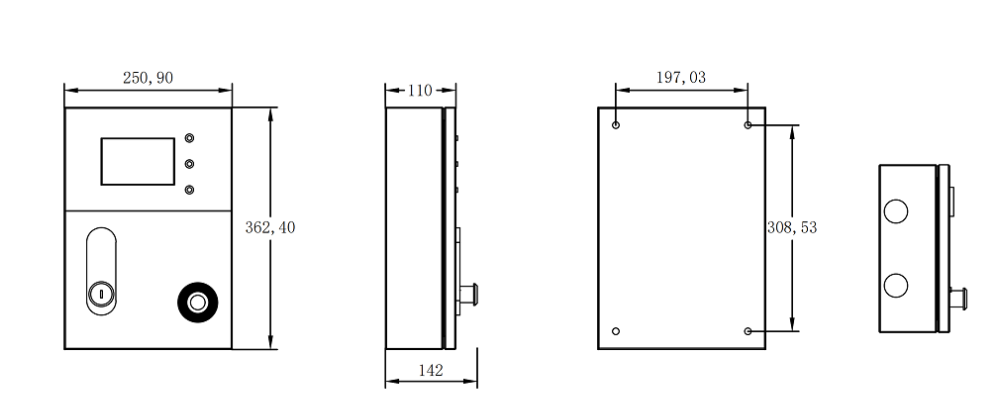
Control Box

Inside the control box

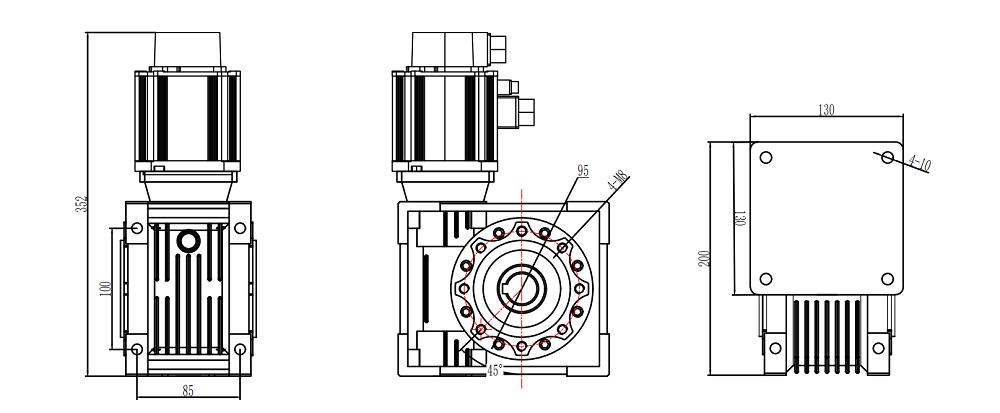
Motor unit
| Z5MJ-220 Series Specifications/Application Guide | |||
| Technical description/Parameter values | |||
| Specifications | Z5MJ-220 | Power output | 2.2kW |
| Input Voltage | 220V±10% | Input Frequency | 50Hz |
| Motor Rated Current | 10A | Motor Rated Torque (N·m) (Motor with 4 pole pairs) |
7.7 N·m (1.5x Overload Capacity) |
| Motor Rated Maximum Speed (RPM) (Motor with 4 pole pairs) |
2500 rpm (Optical Encoder) | Motor Protection Rating | IP65 |
| Standard Power Line/ Encoder Cable Length (m) |
3.5m | Limit Switch (Encoder) (Magnetic Encoder Bit) |
|
| Self-locking Method | Electronic mechanical brake | Ambient Temperature (℃) | (-20~50)℃ |
| Control Box Dimensions (mm) | 362mm(L)*251mm(W)*110mm(H) | Motor size | Refer to Dimensional Drawing for Accuracy |
| Reducer | RV63 | ||
| Control Panel Functions | |||
| Display Screen | 4.3-inch Programmable Touchscreen | Door Opening/Closing Speed Setting (RPM) | Motor Rated Speed |
| Door Opening/Closing Acceleration/Deceleration Setting (ms) | / | Automatic Door Closing Delay Time (s) | 0-300秒(s) |
| Partial Door Opening Height (%) | Customizable Height within the Limit Range | Operation Status Display Selection | Main Interface |
| Control Panel Expansion Functions | |||
| Language Display | Chinese & English Chinese & English (Other languages customizable) |
Historical Fault Inquiry | (√) |
| Jog Mode | (√) | Motor Forward/Reverse Operation | (√) |
| Interface Logic Switching (NC/NO) | (√) | Low Temperature Anti-freeze Function | (√) |
| Control Box Interfaces | |||
| Network Communication Interface | RS485 | Safety Protection Signal Input | Emergency Stop Action |
| Automatic Full Opening Signal Input | (√) | Partial Open Signal Input | (√) |
| Single-button Cycle Control | (√) | Interlock Input | (√) |
| Programmable Relay Output | 2 Sets (Expandable) | Programmable Diode Output | 2 Sets (Expandable) |
| Manual/Automatic Switching Input | Touchscreen Switching | Emergency Stop Input | (√) |
| Supported limit types | Motor with Built-in Multi-turn Absolute Encoder | ||
| Z5MJ-220 Motor Compatibility Recommendations | |||||
| Motor Power | Gearbox Ratio | Applicable Area for Ø114 Roller | Applicable Weight for Ø114 Roller | Applicable Area for Ø140 Roller | Applicable Weight for Ø140 Roller |
| 2.2kW | 1:15 | / | / | <28 m² | <113kg |
| 1:25 | / | / | <47 m² | 188kg | |
Working principle of high-speed rolling door servo control system
The high-speed rolling door servo control system is a precision system integrating mechanical transmission, electronic control and sensor feedback. Its core function is to realize high-speed, stable and safe opening and closing of rolling doors by accurately controlling the operation of motors.
The servo control system consists of four parts: drive unit, execution unit, detection unit and control unit. Each module cooperates to form a closed-loop control chain:
Drive unit: Contains servo driver (power amplifier module), responsible for converting control signals into current/voltage signals recognizable by the motor, while receiving motor feedback data and adjusting output power to adapt to load changes (such as door weight, wind resistance).
Execution unit: mainly refers to servo motor (mostly permanent magnet synchronous motor), which converts electrical energy into mechanical energy through gearbox or directly drives the rolling door reel to drive the door to rise and fall.
Detection unit: It consists of encoder (position detection), Hall sensor (current/speed detection), safety sensor (such as infrared beam, pressure feedback strip), real-time acquisition of door position, running speed, obstacle information.
Control unit: With microprocessor (MCU) as the core, built-in control algorithm, receiving external commands (such as remote control, radar sensing) and feedback signals from detection units, calculating and outputting control commands.
The system realizes precise control of the door body through the closed-loop logic of "command input → signal processing → execution adjustment → feedback correction". The specific process is as follows:
Command trigger
External signals (such as manual buttons, radar sensing, PLC linkage commands) are transmitted to the control unit to clarify the door body's "open", "close", "pause" and other action requirements, and set the target speed (such as 1.5m/s) and end position (such as the reel rotation angle when fully opened).
Signal processing and command output
The control unit calculates the required operating parameters (speed, torque) of the motor through a preset algorithm (such as PID adjustment algorithm) based on the door body parameters (weight, curtain material) and current status (such as whether there are obstacles), and sends the signal to the drive unit.
Motor execution and door body movement
The drive unit amplifies the control signal into a current signal that the motor can execute, drives the servo motor to rotate at the set speed, and drives the rolling door to rise and fall through the transmission mechanism (roller, guide rail). At this time, the motor speed is proportional to the door body lifting speed (for example, the motor speed of 1000r/min corresponds to the door body speed of 1.2m/s).
Real-time feedback and dynamic correction
The encoder records the motor rotation angle in real time, converts it into the current position of the door body (such as "1.2 meters from the ground"), and feeds it back to the control unit;
The Hall sensor monitors the change of motor current to determine whether the load is abnormal (such as a sudden increase in current when encountering an obstacle);
The control unit compares the "actual state" with the "target state". If there is a deviation (such as speed fluctuation, position offset), it will immediately adjust the drive signal:
When the speed deviation occurs, the speed is corrected by adjusting the motor voltage (if the door body is too slow, the output power is increased);
When the position deviation occurs, the "dynamic compensation algorithm" is started. If the door body slows down due to track friction, the torque is automatically increased to maintain the set speed;
When encountering an obstacle, the sensor triggers an emergency signal, and the control unit instructs the motor to reverse or stop within 0.1 seconds to avoid collision.
Action termination and state memory
When the encoder detects that the door body has reached the target position (such as the mechanical limit or preset angle when fully closed), the control unit sends a stop command, the motor is powered off and locked through the brake device, and the current position information is stored at the same time (even if the power is off, it will not be lost) to ensure accurate reset at the next start.
The "high speed" (usually 1-2.5m/s) and "stable" requirements of high-speed rolling shutter doors place strict demands on the control system. The core technologies are reflected in the following aspects:
PID closed-loop regulation algorithm: Through the dynamic adjustment of proportional (P), integral (I), and differential (D) parameters, interference (such as wind force and track resistance changes) is suppressed in real time. For example, when the door body encounters strong wind resistance, the system will automatically increase the motor torque to maintain a stable speed and avoid jamming.
Acceleration and deceleration curve control: When the door body starts, an "S-shaped acceleration and deceleration curve" (rather than sudden full speed) is used to reduce mechanical shock (such as excessive torque at the moment of starting, causing the curtain to tear), while reducing noise (reduced by more than 15dB compared to traditional linear acceleration and deceleration noise).
Multi-sensor fusion judgment: When the infrared sensor detects an obstacle, the system will combine the speed sensor data to determine whether it is a "false trigger" (such as fallen leaves floating by), and only trigger an emergency stop when a real obstacle is confirmed (such as continuous blocking for more than 0.3 seconds), avoiding frequent starts and stops that affect efficiency.
Power-off protection mechanism: Equipped with supercapacitor or backup power supply, the current position data is saved at the moment of power failure, and the door body is locked by mechanical brake to prevent the door body from falling due to gravity. After power is restored, it can be directly restored to the state before power failure.
As one of the leading z5mj-220 4 pole pairs series products manufacturers and suppliers in China, we warmly welcome you to buy the best z5mj-220 4 pole pairs series products at competitive price from our factory. For more company information, contact us now.