

In the world of industrial automation, the seamless interaction between different components is crucial for achieving optimal performance and efficiency. One common question that often arises is whether a servo drive amplifier can communicate with a Programmable Logic Controller (PLC). As a supplier of Servo Drive Amplifier, I am well - versed in this topic and will delve into the details in this blog post.
Understanding Servo Drive Amplifiers and PLCs
Before we explore the communication aspect, let's first understand what servo drive amplifiers and PLCs are. A servo drive amplifier is a device that amplifies the control signals received from a motion controller and provides the necessary electrical power to drive a servo motor. It plays a vital role in controlling the speed, torque, and position of the servo motor with high precision.

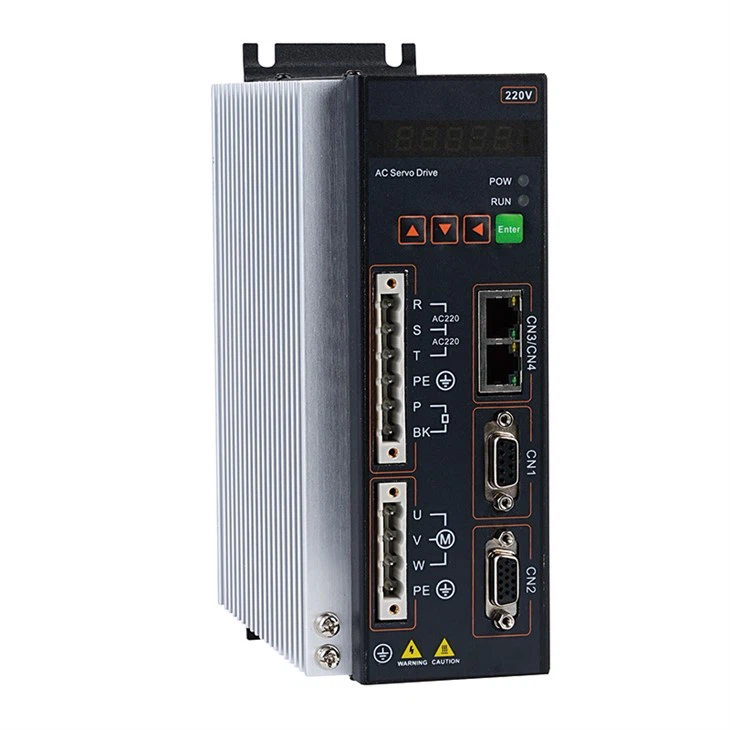
On the other hand, a PLC is an industrial computer used to automate various processes in manufacturing, assembly lines, and other industrial applications. It can be programmed to perform a wide range of tasks, such as monitoring sensors, controlling actuators, and making decisions based on input signals. PLCs are known for their reliability, flexibility, and ease of programming.
The Need for Communication
In industrial automation systems, the ability of a servo drive amplifier to communicate with a PLC is essential for several reasons. Firstly, it allows for centralized control. By connecting the servo drive amplifier to a PLC, operators can control multiple servo motors from a single location. This simplifies the overall system management and reduces the complexity of wiring and control.
Secondly, communication enables real - time monitoring and feedback. The PLC can receive data from the servo drive amplifier, such as motor speed, torque, and position. This information can be used to monitor the performance of the servo motor, detect any faults or abnormalities, and make necessary adjustments in real - time.
Thirdly, it facilitates synchronization. In applications where multiple servo motors need to work together in a coordinated manner, communication between the servo drive amplifier and the PLC ensures that the motors operate in sync. This is crucial for achieving accurate and efficient motion control in processes such as robotic assembly, packaging, and material handling.
Communication Methods
There are several ways in which a servo drive amplifier can communicate with a PLC. The choice of communication method depends on various factors, such as the distance between the devices, the required data transfer rate, the level of complexity, and the specific requirements of the application.
Serial Communication
Serial communication is one of the most common methods used for communication between a servo drive amplifier and a PLC. It involves the transmission of data one bit at a time over a single communication line. Serial communication protocols such as RS - 232, RS - 485, and Modbus are widely used in industrial applications.
RS - 232 is a standard serial communication protocol that is commonly used for short - distance communication. It is relatively simple to implement and is suitable for applications where the data transfer rate is not very high. RS - 485, on the other hand, is a differential signaling protocol that allows for longer - distance communication and can support multiple devices on the same communication line.
Modbus is an open - source serial communication protocol that is widely used in industrial automation. It provides a simple and efficient way to exchange data between different devices, including servo drive amplifiers and PLCs. Modbus can be used over both RS - 232 and RS - 485 communication lines.
Ethernet Communication
Ethernet communication is becoming increasingly popular in industrial automation due to its high data transfer rate, long - distance capabilities, and compatibility with existing network infrastructure. Ethernet - based communication protocols such as Ethernet/IP, Profinet, and EtherCAT are commonly used for communication between servo drive amplifiers and PLCs.
Ethernet/IP is an industrial Ethernet protocol that is based on the Common Industrial Protocol (CIP). It provides a standard way to communicate with different industrial devices, including servo drive amplifiers and PLCs. Profinet is another industrial Ethernet protocol that is widely used in Europe. It offers high - speed communication and real - time capabilities.
Ethercat Motor Driver is a high - performance industrial Ethernet protocol that is specifically designed for motion control applications. It provides extremely fast data transfer rates and low latency, making it ideal for applications where real - time control is required. EtherCAT allows for the connection of multiple servo drive amplifiers and other devices in a daisy - chain topology, which simplifies the wiring and reduces the overall system cost.
Implementing Communication
Implementing communication between a servo drive amplifier and a PLC requires careful planning and configuration. The first step is to select the appropriate communication method based on the requirements of the application. Once the communication method is selected, the next step is to configure the servo drive amplifier and the PLC to use the chosen communication protocol.
This typically involves setting up parameters such as the baud rate, data format, communication address, and communication mode. In some cases, additional software or firmware may need to be installed on the servo drive amplifier and the PLC to support the communication protocol.
After the configuration is complete, the servo drive amplifier and the PLC need to be physically connected using the appropriate communication cable. Once the connection is established, the communication between the two devices can be tested to ensure that it is working correctly.
Challenges and Solutions
While the communication between a servo drive amplifier and a PLC offers many benefits, it also presents some challenges. One of the main challenges is the compatibility between different devices and communication protocols. Not all servo drive amplifiers and PLCs support the same communication protocols, which can make it difficult to establish a connection.
To overcome this challenge, it is important to choose devices that are compatible with each other. Many manufacturers offer servo drive amplifiers and PLCs that support multiple communication protocols, which provides greater flexibility and compatibility.
Another challenge is the interference and noise in the communication environment. Industrial environments are often noisy, and electrical interference can disrupt the communication between the servo drive amplifier and the PLC. To mitigate this problem, shielded communication cables can be used, and proper grounding and filtering techniques can be applied.
Conclusion
In conclusion, a servo drive amplifier can indeed communicate with a PLC, and this communication is essential for achieving efficient and effective industrial automation. There are several communication methods available, each with its own advantages and disadvantages. By carefully selecting the appropriate communication method and implementing it correctly, operators can enjoy the benefits of centralized control, real - time monitoring, and synchronization.
As a supplier of Servo Drive Amplifier, we understand the importance of seamless communication in industrial automation systems. Our servo drive amplifiers are designed to support a wide range of communication protocols, ensuring compatibility with various PLCs. If you are interested in learning more about our products or have any questions regarding the communication between servo drive amplifiers and PLCs, we encourage you to contact us for further discussion and potential procurement.
References
- "Industrial Automation Handbook", John Wiley & Sons
- "Motion Control Technology", Elsevier
- Technical documentation from various servo drive amplifier and PLC manufacturers