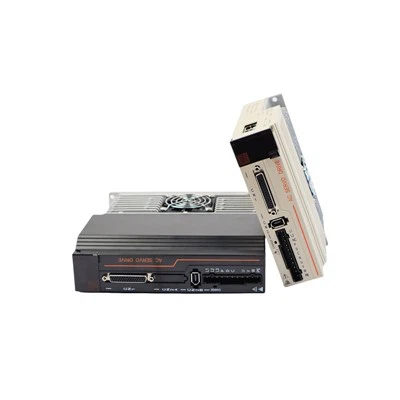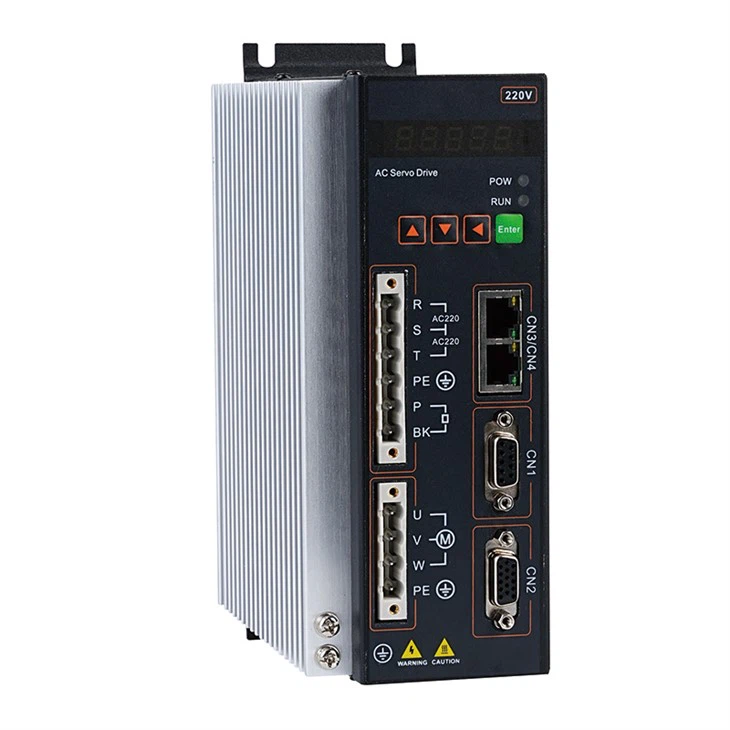
EtherCAT Motor Drivers are key components in industrial automation, particularly suited for multi-axis collaborative operation. They ensure efficient and precise control system operation. The store's featured product, the Zhongzhi one-to-three servo controller, supports the EtherCAT protocol, boasts a rated current of 1.6A and a power output of 2000W, meeting a wide range of complex industrial needs. This drive utilizes IGBT PWM control, sinusoidal current drive, and IP10 protection, making it suitable for environments below 1000m in altitude and with humidity below 90%. It also supports custom processing, with encoder feedback options of 17-bit or 23-bit, providing flexibility for diverse application scenarios.
Ethercat Motor Driver Manufacturer
Amid the rapid development of intelligent industrial automation, our Ethercat servo drives leverage Ethercat bus technology, combining the high precision and high dynamic performance of traditional servos to revolutionize control and communication. They offer microsecond-level communication capabilities, achieving data transmission rates over 10 times higher than traditional buses, enabling latency-free multi-axis collaboration. Through a "logic synchronization" mechanism, multi-axis synchronization accuracy reaches ±1ns, ensuring efficient collaboration. 100Mbps full-duplex communication provides full-link data transparency, facilitating predictive maintenance and reducing downtime by over 40%. Compatible with multiple systems, they support hot-swappable and online configuration, reducing upgrade costs. Their double-isolation design offers strong interference resistance, ensuring stable operation in harsh environments. Equipped with proprietary algorithms, they dynamically adjust within 0.1ms, adapting to a variety of demanding scenarios. They lead the way in automated production with "high-speed communication + precise control."

Application of EtherCAT Technology in Servo Drives
EtherCAT Technology
EtherCAT is a high-performance, real-time Ethernet communication technology first introduced by Beckhoff in Germany in 2003 and now widely used in industrial automation. It utilizes a distributed clock synchronization mechanism to synchronize communication between all slave devices and the master, ensuring high-precision and fast data transmission. EtherCAT also employs a transparent transmission mechanism, facilitating integration with existing Ethernet devices and streamlining system integration. Compared to industrial communication protocols such as CANopen, PROFINET, Ethernet/IP, and Ethernet Powerlink, EtherCAT offers superior real-time performance, with microsecond-level data transmission latency. It supports concurrent communication with multiple slave devices, facilitating system expansion and integration, and offers low implementation costs, making it suitable for large-scale system integration and control.
In industrial Ethernet networks utilizing EtherCAT technology, communication between the master and slaves in the network is accomplished through process data communication. The master first sends process control commands to the slaves. After receiving and executing the commands, the slaves transmit feedback on the servo device status to the master via process data communication, completing a control cycle.
Connecting to EtherCAT Slave devices in the network can directly access data packets. After reading the corresponding command and control information from the packets, they also insert their own status information into the packets. The slave device then completes processing of the Ethernet information frame and transmits the data packet to the nearest connected slave device. The next slave device repeats the above process. When the data packet is transmitted to the end device of the network through the EtherCAT network and the corresponding operation is completed, the data packet containing the status of the previous slave device is sent back along the original route. When the message returns to the first slave device in the network, the slave device generates a corresponding message and sends it to the EtherCAT master station of the network. The network data processing during EtherCAT communication fully utilizes the full-duplex communication characteristics of Ethernet.
The EtherCAT communication hardware processing layer is implemented by the ESC core. This hardware generates a very small data processing delay, typically 100-500ns. Therefore, the ESC hardware's communication latency performance is independent of the response time of the main control chip in industrial EtherCAT slave devices.
The EtherCAT communication protocol is a secondary development based on the standard Ethernet message frame. The EtherCAT message frame format is defined in the Ethernet message frame data portion and consists of an Ethernet message frame header, an EtherCAT message frame header, EtherCAT data, and a Fieldbus Control System (FCS) frame checksum. Ethernet messages with the EtherCAT data type of 0x88a4 are typically forwarded and processed directly by the ESC. Tonghang's solution uses a PRU core to implement the ESC module functions, bypassing the ARM core for processing. This hardware configuration ensures extremely low forwarding latency and cycle time. The ESC utilizes a receive buffer (RX First Input First Output, RX FIFO) and omits a transmit buffer (TX First Input First Output, TX FIFO). The RX FIFO is used to reduce forwarding latency. The RX FIFO is used to isolate the receiving and processing of distributed clock (DC) clocks.
The EtherCAT application layer architecture connects the data link layer and the user application layer. This application layer directly interacts with user applications to implement the functions and control tasks required by user programs. This application layer is closely linked to the communication protocol and provides users with a rich API interface for controlling the underlying hardware. EtherCAT communication technology supports multiple protocols and device profiles, including the CiA402 profile in the CANopen protocol and the SoE and CoE profiles in the SERCOS protocol. This article uses the CoE protocol to implement application layer communication. The communication methods primarily include cyclic process data objects (PDOs) and acyclic mailbox communication (SDOs). The following describes these two key communication functions and their state machine transitions.
(1) Cyclic process data communication (PDO)
In cyclic process data communication, the process data may contain multiple data objects that are mapped to PDOs
The PDO data list of the SM channel is defined by the CoE protocol, which allocates data objects from 0x1c10 to 0x1c2f. Hardware devices of different complexity have different data object mapping forms: simple devices directly use fixed process data, do not need mapping, and do not require SDO protocol; read-only PDO mapping, also uses fixed process data, and needs to use SDO protocol to read; optional PDO mapping, multiple fixed PDOs are selected through PDO allocation object 0xlc1x, and need to use SDO protocol selection; variable PDO mapping. Use CoE protocol for configuration, and the PDO content can be changed.
(2) Acyclic mailbox data communication (SDO)
The EtherCAT master uses SM The synchronization manager channel is used to interact with the slave station for mailbox data. This data interaction is a standard parameter exchange method. In the event of an emergency, the error event of the slave device is triggered, and the error status and diagnostic information are sent to the master station. In this case, non-periodic mailbox data communication is required to complete the communication task.
(3) State machine and its state switching
When the EtherCAT slave station uses the CiA402 protocol framework to implement motion control applications, it needs to use two state machines for state switching, including the EtherCAT state machine for communication and the CiA402 state machine for motion control. The EtherCAT state machine can be divided into three parts according to the request and response mechanism of the master station: state request, execution state switching and state machine completion switching. The state switching of the slave station is initiated by the master station and the slave station responds to the request. The state machine is divided into four basic states, including (INIT) initialization state, (PRE-OP) pre-operation state, (SAFE-OP) safe operation state and (OP) normal operation state.
CiA402 The state machine includes eight states: not ready for power on, unable to power on, ready for power on, power on, operational, emergency stop, error response, and error state. In the motor control program, the two state machines work together at the communication layer.
Hot Tags: ethercat motor driver, China ethercat motor driver manufacturers, suppliers, factory, AC Servo Amplifier, AC Servo Motor Controller, Digital Servo Drive, Electric Servo Drive, Servo Drives Motor Solutions, Servo Motors Drives