

As a supplier of low voltage servo drives, I've encountered numerous inquiries regarding the frequency response of these essential components. Understanding the frequency response of a low voltage servo drive is crucial for optimizing its performance in various applications. In this blog, we'll delve into what frequency response means, why it matters, and how it impacts the operation of low voltage servo drives.
What is Frequency Response?
Frequency response refers to the way a system, in this case, a low - voltage servo drive, responds to input signals of different frequencies. It is a measure of how well the drive can accurately reproduce an input signal at various frequencies. When we talk about a servo drive, the input signal is typically a command that tells the motor how to move, and the output is the actual movement of the motor.
Mathematically, the frequency response of a system can be described using transfer functions. A transfer function is a mathematical representation that relates the output of a system to its input in the frequency domain. For a low voltage servo drive, the transfer function helps us understand how the drive will respond to different frequencies of control signals.
Importance of Frequency Response in Low Voltage Servo Drives
The frequency response of a low voltage servo drive is of utmost importance for several reasons. Firstly, in applications where high - speed and precise motion control is required, such as robotics and CNC machining, a good frequency response ensures that the motor can accurately follow rapid changes in the control signal. For example, in a robotic arm that needs to perform quick and precise movements, a servo drive with a poor frequency response may cause the arm to lag behind the commanded motion, resulting in inaccurate positioning and reduced productivity.
Secondly, frequency response affects the stability of the servo system. If the drive has a poor frequency response, it may lead to oscillations or instability in the motor's operation. This can not only damage the motor but also cause the entire system to malfunction. A well - designed frequency response helps to maintain the stability of the servo system, ensuring smooth and reliable operation.
Factors Affecting the Frequency Response of Low Voltage Servo Drives
Several factors can influence the frequency response of a low voltage servo drive. One of the primary factors is the bandwidth of the drive. Bandwidth is defined as the range of frequencies over which the drive can operate effectively. A higher bandwidth means that the drive can respond to higher - frequency signals, allowing for faster and more precise motion control. However, increasing the bandwidth also comes with challenges, such as increased noise and reduced stability.
The type of control algorithm used in the servo drive also plays a significant role in its frequency response. Different control algorithms, such as proportional - integral - derivative (PID) control, have different characteristics in terms of their ability to handle different frequencies. For example, a well - tuned PID controller can improve the frequency response of the servo drive by adjusting the gain and integral time constants to optimize the system's performance at different frequencies.
The mechanical characteristics of the load connected to the servo motor can also affect the frequency response. The inertia of the load, for example, can cause the motor to respond differently to input signals. A high - inertia load may require a servo drive with a different frequency response compared to a low - inertia load to ensure accurate and stable motion control.
Measuring the Frequency Response of Low Voltage Servo Drives
To determine the frequency response of a low voltage servo drive, several measurement techniques can be used. One common method is the frequency sweep test. In this test, a sinusoidal input signal is applied to the drive, and the output of the motor is measured as the frequency of the input signal is varied. By analyzing the amplitude and phase of the output signal at different frequencies, the frequency response of the drive can be determined.
Another method is the use of a spectrum analyzer. A spectrum analyzer can measure the frequency components of the input and output signals of the servo drive and provide a detailed analysis of the drive's frequency response. This method is particularly useful for identifying any resonant frequencies or other frequency - related issues in the servo system.
Applications and the Role of Frequency Response
In different applications, the requirements for the frequency response of low voltage servo drives vary. In industrial automation, for example, where conveyor belts need to be precisely controlled, a servo drive with a moderate frequency response may be sufficient. However, in high - precision applications such as semiconductor manufacturing, where the movement of wafers needs to be extremely accurate, a servo drive with a high - frequency response is essential.
In the field of medical equipment, such as robotic surgical systems, the frequency response of the servo drive is critical for ensuring the safety and effectiveness of the procedures. A high - quality frequency response allows for precise and smooth movements of the surgical instruments, reducing the risk of errors during surgery.
Our Low Voltage Servo Drives and Frequency Response
As a supplier of low voltage servo drives, we understand the importance of frequency response in different applications. Our servo drives are designed with advanced control algorithms and high - quality components to ensure excellent frequency response. We offer a range of products, including Servo Drive Amplifier, CANopen Servo Drive, and Ethercat Motor Driver, each tailored to meet the specific frequency response requirements of different industries.
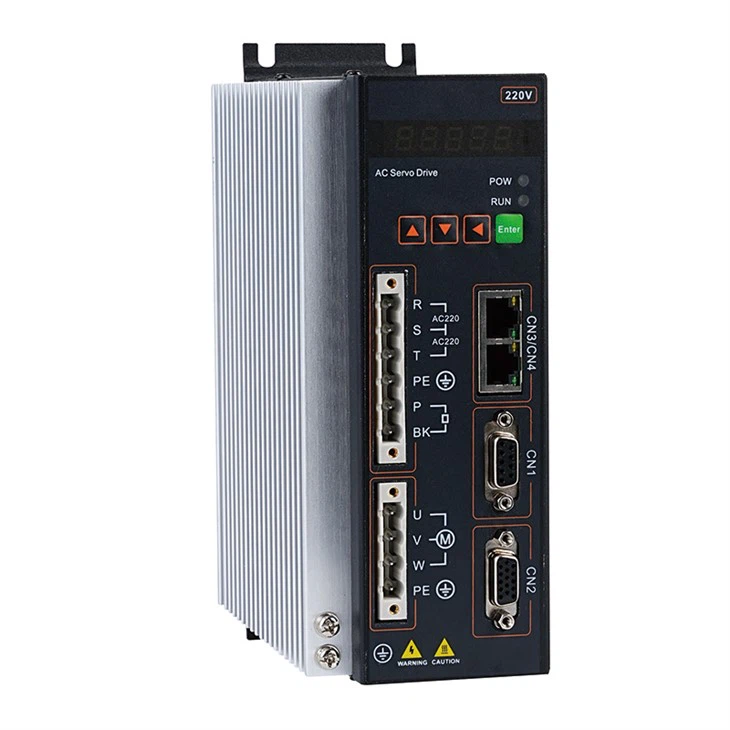

Our engineers work closely with customers to understand their application needs and provide customized solutions. Whether it's a high - speed robotic application or a precision medical device, we can recommend the most suitable servo drive with the optimal frequency response for the job.
Contact Us for Your Low Voltage Servo Drive Needs
If you're in the market for a low voltage servo drive and need a product with excellent frequency response, we're here to help. Our team of experts can provide you with detailed information about our products, answer your questions, and assist you in selecting the right servo drive for your application. Contact us today to start the procurement process and take your motion control system to the next level.
References
- Dorf, R. C., & Bishop, R. H. (2016). Modern Control Systems. Pearson.
- Franklin, G. F., Powell, J. D., & Emami - Naeini, A. (2015). Feedback Control of Dynamic Systems. Pearson.