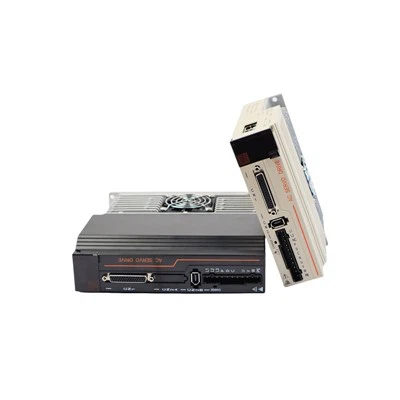
What is Electric Servo Drive
An electric servo drive is an electronic device used to control the operation of a servo motor. By receiving control signals such as position, speed, and torque commands, it precisely adjusts the motor's output, achieving high-speed and high-precision motion control.
It integrates power amplification, signal processing, and feedback control functions, and is widely used in industrial automation, robotics, CNC machine tools, and other fields. As the core component of servo systems, it ensures stable and precise motor movement according to commands.
Hardware System Implementation of Servo Controller
Main Power Circuit Hardware Design
The main power supply unit's input power is divided into control power (220V) and power power (380V). After the main power circuit self-tests and returns normal, the system controls the disconnection and connection of the 380V input power supply.
The input power supply is rectified and filtered to obtain a DC bus voltage, which serves as the bus voltage input for each subsequent power circuit.
The alarm detection circuit performs real-time detection of undervoltage, overvoltage, phase loss, and DC bus abnormalities. If an abnormality is detected, an alarm is generated and monitored by the control system.
Control Circuit Hardware Design
The control circuit adopts a DSP + FPGA architecture. The DSP is the core of the servo system, implementing motor vector control algorithms with a maximum clock frequency of 150MHz.
It provides rich peripheral interfaces including CAP, QEP encoder interface, 12-bit ADC, PWM output, SCI, SPI, and eCAN communication.
Motor phase current is detected using Hall sensors and converted into 0–3V voltage signals, which are processed via ADC channels.
External input signals are isolated using optocouplers and then level converted before entering DSP I/O ports.
The FPGA handles encoder data (17-bit absolute), communication, LED display, alarm detection, and high-speed data exchange with DSP via dual-port RAM.
Power Circuit Hardware Design
Different power modules are selected based on requirements. A 1200V / 50A IGBT module forms a three-phase inverter and braking circuit with integrated driver and protection features.
The system supports protection against overvoltage, overcurrent, overheating, and undervoltage. PWM signals are isolated via high-speed optocouplers before driving the IPM.
Fault signals are detected in real time. When detected, the DSP disables PWM output immediately and triggers alarm processing.
Motor current is measured via Hall sensors on U and W phases and transmitted to DSP ADC channels for processing.
The control power supply uses a switching power design, providing compact size, high reliability, wide input range, and low ripple.
Servo Controller Software Implementation
Main Program
The software is written in C using a modular design. The main program handles DSP initialization (clock, SPI, ADC, CAN, SCI, I/O, interrupts), servo parameter calculation, and non-real-time tasks.
PWM Interrupt Routine
The PWM interrupt executes every 100µs and performs real-time control tasks including encoder data acquisition, current sampling (Iu, Iw), PID control, Clark/Park transforms, SVPWM algorithm execution, and PWM signal generation. Every 10 cycles, speed calculation and speed loop control are executed.
Tonghang Product Series and Selection Guide


Hot Tags: electric servo drive, China electric servo drive manufacturers, suppliers, factory, AC Servo Amplifier, AC Servo Motor Driver, Brushless AC Servo Drive, Low Voltage Servo Drive, Servo Control Drive, small servo motors and drives