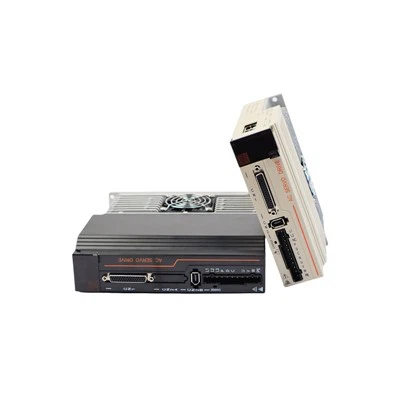
Zhejiang Tonghang E-Drive Technology Co., Ltd. is one of the most reliable manufacturers and suppliers of ac servo motor controller in China. The company has world-leading production equipment and strong manufacturing capabilities. Please rest assured to buy the best ac servo motor controller from our factory.
Machine builders often face different motion requirements when developing automated equipment. Some machines need accurate indexing, others require continuous speed adjustment, while certain production processes depend on controlled torque. An AC Servo Motor Controller forms part of the electrical system used to coordinate these requirements, working with the servo drive, motor, feedback components, and machine-level control devices. Its suitability depends on how well the selected components match the machine's operating tasks.
For equipment manufacturers, choosing a control system is not simply a matter of comparing rated power. The command source, communication interface, encoder arrangement, installation space, and future maintenance requirements should also be considered. Zhejiang (Hangzhou) Tonghang E-Drive Technology Co., Ltd. develops different servo drive and motor product series for industrial equipment applications, giving customers several configurations to evaluate during project planning.
1. Start with the Machine's Actual Motion Requirements
Before selecting electrical components, engineers should understand what the machine is expected to do. A feeding mechanism, for example, may need to move a material strip by a specified distance before the next production step begins. A rotating worktable may need to stop repeatedly at different processing positions. A winding mechanism may require stable tension while the material roll changes in diameter.
Although these applications all involve motor movement, their operating priorities are different. A suitable control arrangement should therefore be developed around the machine's working cycle rather than selected solely from a general equipment category.
Movement pattern:
Determine whether the motor needs to perform repeated positioning, continuous rotation, acceleration and deceleration, or coordinated movements with other mechanisms.
Mechanical load:
Consider the load characteristics, transmission structure, operating frequency, and expected changes in resistance during machine operation.
Control requirements:
Identify whether the equipment uses pulse commands, analog references, or an industrial communication network to transmit movement instructions.
Operating environment:
Review the available installation space, electrical cabinet arrangement, cable routing, ambient conditions, and access requirements for maintenance.

2. Match the Control Method to the Production Task
Different production processes place different demands on motor behavior. Engineers should identify the variable that needs to be controlled most directly and then evaluate the available drive functions. Position, speed, and torque control are three common operating methods, but their application value depends on the machine's mechanical design and process requirements.
Position-based operation
When a mechanism needs to reach a defined location, the control system must organize the movement distance and target position. Typical examples include automatic feeders, indexing platforms, material handling units, and equipment that repeatedly moves between processing stations. The required positioning method should be matched with the controller's command output and the drive's supported interface.
Speed-based operation
Some machines operate through continuous rotation rather than repeated positioning. In these cases, the control system needs to adjust motor speed according to the production process. Conveying equipment, rotating mechanisms, and certain processing machines may use speed references from an analog signal, pulse command, or supported communication interface.
Torque-based operation
Where the mechanical process depends on applied force, torque regulation becomes an important consideration. Winding, unwinding, pressing, and tension-related equipment are examples in which the relationship between motor output and mechanical resistance needs to be evaluated during system design.
Some machines may use more than one operating method during a production cycle. For example, an axis may perform position-controlled movement before switching to another operating condition. Engineers should confirm whether the selected drive supports the required control modes and transition logic rather than assuming that every model offers identical functions.
3. Explore Tonghang Servo Drive Series for Different Equipment Designs
Equipment manufacturers may have different preferences for drive structure, feedback compatibility, and communication methods. Tonghang provides several product families covering general-purpose applications, compact single-board designs, absolute feedback configurations, industrial bus communication, and spindle-related equipment. When evaluating an AC Servo Motor Controller configuration, buyers can use these product categories as a starting point for comparing the technical requirements of their machines.


The series should be compared according to their documented functions rather than appearance or model naming alone. For example, a machine using an industrial network needs a compatible communication arrangement at both controller and drive ends. Equipment using absolute feedback must also consider the encoder specifications and the corresponding drive compatibility. Reviewing the individual product pages can help narrow down the available models before a detailed technical discussion.
4. Plan the PLC Interface and Signal Allocation
The PLC is responsible for coordinating the machine's overall operating logic. Its input channels collect signals from sensors, switches, and other devices, while output channels transmit instructions to connected equipment. When a servo system is included, the controller must also provide the appropriate command interface or network connection for the selected drive.
In the described machining equipment configuration, a PLC is used as the main control platform. The system also includes an HMI for operator input and a PROFINET connection for communication with the servo drive. This arrangement allows machine sequences to be managed centrally while motor-related functions are handled by the drive.
The stated controller configuration includes the following resources:
Digital signal channels: The main unit has 8 digital inputs and 6 digital outputs, with expansion capability for additional I/O points.
Analog signal acquisition: Two analog input channels are available for supported analog signal applications.
Pulse-related functions: Four high-speed counters and four pulse outputs are provided for applicable signal processing and motion command tasks.
Network connection: Two industrial Ethernet communication ports support the described PROFINET arrangement.
The controller also has a 75KB data storage area for program storage and HMI-to-PLC data communication. This resource can be used as part of the application program and operator interface data arrangement.
During engineering, the I/O list should be prepared before wiring begins. Each input and output needs a clearly defined function, signal type, and corresponding terminal assignment. Network settings and data mapping should also be documented so that the PLC and drive use consistent communication parameters.
It is important to verify the actual communication functions supported by the selected devices. The controller's network interface alone does not guarantee that every motion function is available; the drive protocol, device configuration, and control program must also meet the project requirements.
5. Check Motor, Encoder, and Installation Compatibility
Electrical compatibility is only one part of a successful servo installation. The motor must also fit the machine's mechanical structure, and its feedback device must be supported by the selected drive. Before confirming a configuration, equipment manufacturers should compare the motor's rated power and operating requirements with the mechanical load, transmission ratio, and expected duty cycle.
For the specific demonstration configuration described here, Tonghang servo drive and motor units with a rated power of 0.1kW are used. The setup includes a PROFINET interface based on the stated PROFIdrive protocol, together with an incremental encoder featuring an 8mm blind hollow shaft.
Rated power: The selected drive and motor configuration is rated at 0.1kW.
Network interface: PROFINET communication is provided for connection with the compatible host controller through the stated PROFIdrive protocol.
Encoder arrangement: The described motor uses an incremental encoder with an 8mm blind hollow shaft.
Mechanical mounting: A universal stator coupling is available for common mounting-hole spacing requirements.
Cable direction: Axial or radial cable routing can be considered through the universal cable outlet arrangement.
The described configuration also specifies an IP65 protection rating. Installation engineers should check the complete equipment arrangement, including connectors, cable entries, and mounting conditions, when assessing environmental protection. The rating and other configuration details should be reconfirmed against the exact model before ordering.
For applications with different power levels or mechanical requirements, the motor and drive should be selected as a matched combination. Shaft dimensions, encoder type, mounting arrangement, cable direction, and available space should be included in the technical review rather than left until installation.
6. Organize Operator Commands and Machine Status on the HMI
The operator interface should make routine machine operation understandable without exposing unnecessary engineering settings. An HMI can display the machine's current state, accept permitted operating values, and provide access to commonly used commands. Its screen layout should reflect the actual production workflow.
For the described application, an operator can enter a predefined speed value on the touchscreen and select Run. The PLC reads the input, checks the relevant program conditions, and sends the required command to the drive. The motor then operates according to the configured control method.
A Pause command can be included in the operating interface to manage the machine sequence. However, the resulting action depends on the PLC program and the equipment design. It may initiate a controlled stop, suspend a sequence, or perform another predefined action. These behaviors should be clearly defined and tested before production use.
Operating value input: Display the parameters that operators are permitted to adjust, with clear units and acceptable value ranges.
Command layout: Arrange frequently used operating commands in a consistent position and distinguish routine commands from safety-related functions.
Equipment status: Present useful information such as operating state, selected setpoints, and available feedback values.
Alarm information: Use clear fault descriptions to help maintenance personnel identify the affected device or operating condition.
Access levels can be used to separate routine operator functions from engineering settings. This helps reduce accidental parameter changes during production. The HMI should also make a clear distinction between a normal pause, a controlled machine stop, and an emergency stop function, which must be designed according to the machine's applicable safety requirements.
7. Verify the System Before Production Release
A machine should not move directly from electrical installation to full-speed production. Initial testing gives engineers an opportunity to confirm wiring, feedback signals, command direction, communication status, and mechanical response under controlled conditions. The test sequence should be appropriate for the machine and should follow the relevant equipment documentation.
Parameter tuning is another important part of commissioning. Drive settings influence the motor's response to commands and changes in load. A setting that works on an unloaded motor may not produce the same behavior after the motor is connected to the actual transmission and working mechanism.
Tonghang drives provide manual parameter adjustment and optimization functions, including one-click rapid optimization and real-time automatic optimization where supported by the selected model. These functions can assist with setup, but engineers should still evaluate the resulting movement under the intended operating conditions.
Electrical connection review: Inspect the power supply, grounding, motor wiring, encoder cable, and control terminals against the wiring documentation.
Feedback and command test: Confirm that the drive receives the intended command and that the feedback signal responds as expected.
Mechanical movement test: Check motor direction, transmission movement, unusual vibration, and any interference along the operating path.
Communication inspection: Verify network status, device identification, data exchange, and fault reporting between connected equipment.
Production sequence test: Run the defined operating cycle and check normal stops, pauses, alarm handling, and recovery procedures.
After testing, the engineering team should retain the final parameter list, wiring records, device model information, and commissioning results. These documents are useful when maintaining the machine, replacing components, or reproducing the same equipment configuration at another production site.
8. How to Select a Suitable AC Servo Motor Controller for Your Equipment
When comparing an AC Servo Motor Controller for a new machine, buyers should prepare a technical requirement list before requesting quotations. This makes it easier to compare products on the same basis and reduces the possibility of overlooking an important interface or installation condition.
For compact automated equipment:
Review the available installation space, drive dimensions, wiring arrangement, motor power, and the number of axes required by the machine.
For PLC-based production systems:
Identify the PLC model, command method, available I/O resources, and the communication protocol required for exchanging control and status information.
For equipment with encoder requirements:
Provide the encoder type and relevant feedback specifications. Confirm compatibility between the motor feedback device and the selected drive series.
For machine tools and specialized machinery:
Describe the machine's axis functions, spindle or auxiliary motor requirements, operating cycle, and any application-specific control functions.
Other information may also be needed, including input voltage, rated motor power, shaft dimensions, mounting details, cable direction, environmental conditions, and expected production workload. An AC Servo Motor Controller should be evaluated as part of the complete machine configuration, not as an isolated electrical component.
Providing drawings, existing device models, and a description of the operating process can help the supplier understand the application more accurately. It also gives both parties a clearer basis for discussing model selection, technical compatibility, and order specifications.
9. Tonghang's Manufacturing and Engineering Support

Zhejiang (Hangzhou) Tonghang E-Drive Technology Co., Ltd. was founded in 2017 and is a national high-tech enterprise integrating research and development, manufacturing, sales, and after-sales service. The company focuses on electric drive technology and industrial automation, with product development covering different servo drive and motor applications.
Its product range includes servo drives, servo motors, high-speed door servo motor and controller systems, and integrated motor-drive products. Multiple drive families have been developed for different equipment requirements, including general-purpose, single-board, absolute feedback, and bus communication configurations.
Tonghang operates a 5,000㎡ clean workshop equipped with automated machinery and precision testing instruments. These facilities support manufacturing operations and product inspection. The company's development of different product series also reflects its continued work in servo drive technology and industrial motion applications.
For equipment manufacturers, technical communication can begin during the early project planning stage. Customers can provide machine drawings, motor requirements, control platform information, and application details for an initial engineering discussion. This allows the team to understand the intended use before recommending a product configuration.
During project coordination, Tonghang can provide relevant product drawings and performance information, discuss specification adjustments, and communicate configuration details with customers. Reviewing these points before order confirmation helps clarify the selected model, interface requirements, and other technical details associated with the project.
After-sales technical assistance is also part of the company's service process. Customers can contact the team regarding product use, configuration questions, and application-related issues. For equipment projects involving multiple electrical components, providing complete system information can make technical communication more efficient.
FAQ
1. What should be checked before purchasing a servo drive?
Check the motor's rated power, input voltage, encoder type, required control method, command source, communication protocol, and installation conditions. The drive should be compatible with the motor and the machine's control platform.
2. Can a servo drive communicate with a PLC through PROFINET?
Yes, a compatible drive and PLC can exchange data through PROFINET when the required communication functions and device configurations are supported. The protocol implementation, parameter settings, and data mapping should be checked in the technical documentation of both devices.
3. What details should I provide when requesting a model recommendation?
Useful information includes the motor model, rated power, encoder specification, input voltage, control method, PLC model, communication requirements, mechanical installation dimensions, and application description. Drawings and existing equipment information can also support the selection process.
4. Does Tonghang offer assistance with product selection and technical questions?
Yes. Tonghang provides pre-sales engineering consultation, product drawings and performance information, project coordination, and after-sales technical assistance. Customers can share their equipment requirements to discuss suitable product series and configuration details.
Send Your Equipment Requirements to Tonghang
Every automated machine has its own combination of mechanical structure, motor load, command method, and communication requirements. A clear technical review helps equipment manufacturers identify compatible drive and motor configurations before moving into purchasing and installation.
Contact Tonghang with your motor specifications, PLC model, electrical drawings, or machine application details. The engineering team can review the information and discuss relevant product series for your project.
Hot Tags: ac servo motor controller, China ac servo motor controller manufacturers, suppliers, factory, Digital Servo Drive, Electric Servo Motors and Drives, CNC Servo Drive, AC Servo Amplifier, 3 Phase Servo Motor Driver, Compact Servo Drives