

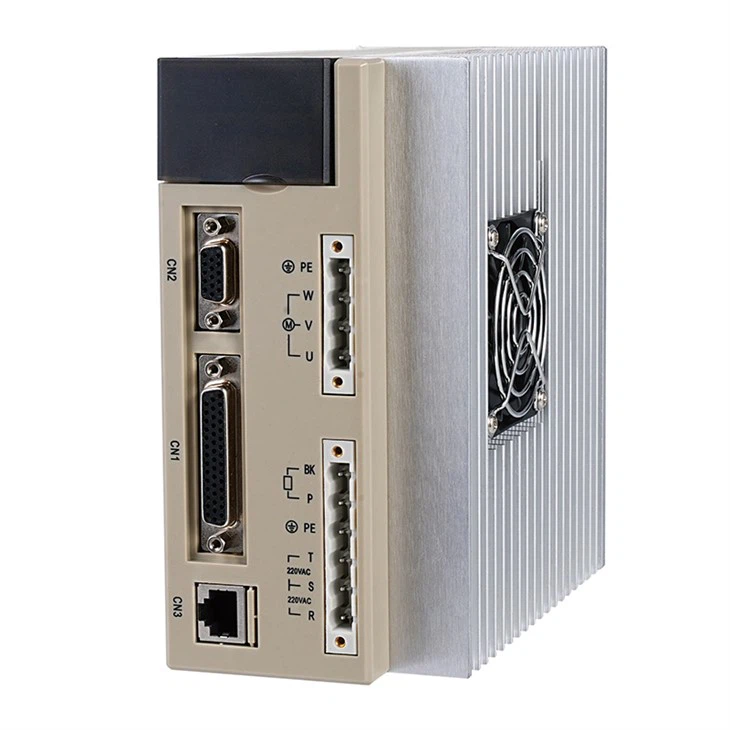
Tonghang, drawing on years of experience in the CNC machine tool industry, has designed a rational control algorithm architecture for general-purpose AC servo drives. By incorporating object-oriented programming concepts from software engineering, we can design servo drive solutions that meet customer requirements.
In CNC machine tool applications, AC-based motor drive control systems have become a mainstream market trend, with the most prominent applications being in machine tool feed shaft and spindle drive systems. The main actuators used include induction variable-frequency motors for spindle drives in simple CNC lathes, permanent magnet synchronous AC servo motors for feed shaft drive control, and asynchronous spindle servo motors for spindle drives in mid- to high-end CNC machine tools such as machining centers. These drive system controllers correspond to general-purpose inverters, AC servo drives, and asynchronous spindle General Servo Drive, respectively.
Currently, most machine tool applications utilize at least two of these drive systems simultaneously, with more complex machines requiring all three. In the current AC servo drive market, many Chinese servo drive system manufacturers often offer only one type of drive controller, or offer different controllers in different product lines. This creates significant workload and difficulty for machine tool users in selection, design, and application, leading to unnecessary waste. While controllers integrating all three types of drive control are available internationally, they are relatively expensive, hindering machine tool manufacturing costs. Therefore, Tonghang has independently researched and designed a universal servo system that integrates multiple drive control systems, filling this gap in China.
Structure and Hardware Design
Combining previous experience developing single-type, dedicated servo drive products and analyzing the hardware architectures of three drive systems, it's clear that the hardware differences between general-purpose inverters, synchronous servo drives, and asynchronous spindle drives are minimal, with the latter two being virtually identical. The following briefly analyzes and explains the main components of the general-purpose servo drive hardware platform shared by all three.
Hardware Architecture
The universal AC servo system adopts a modular design with a common DC bus power supply. It consists of two main components: a motor inverter module and a power supply module.
This common DC bus architecture utilizes centralized power supply rectification and monitoring, implemented by a unified power rectifier module. Each servo inverter module draws power from the DC bus through parallel connections. This centralized approach simplifies the servo hardware architecture and improves system reliability and reduces costs through centralized power supply design, management, and monitoring. This solution is currently widely adopted by CNC system manufacturers, including Siemens.
The following is the basic hardware architecture of a motor inverter module, consisting of a controller and a power stage. The controller is based on a high-performance digital signal processor (DSP), while the power stage is primarily a highly integrated intelligent power module (IPM). The hardware design strives for simplicity, with all control functions implemented in software. Optical encoders or resolvers are used as position feedback sensors, while Hall effect elements are used as current feedback sensors to detect the actual current in two phases. Furthermore, the DC bus voltage is monitored in real time to dynamically adjust the output voltage, and regenerative braking is used to achieve four-quadrant operation of the motor. All detection signals are fed into the DSP via an analog-to-digital converter. They are then integrated and calculated using a high-performance control algorithm. Ultimately, the SVPWM output unit transmits the gate drive signals of the power module to the IPM, achieving motor motion control.

Core Control Device
A 32-bit DSP (TMS320F2812) serves as the core component of the servo control unit. The TMS320F2812 features a low-power design and a system clock frequency of up to 150 MHz. It incorporates a 32x32-bit hardware multiplier, an improved Harvard architecture, independent program and data access buses, a unified memory addressing mode, and supports 4 Mx16-bit memory. It also integrates two dedicated motor control peripherals (Event Managers, EVA, and EVB) to simplify the control system's hardware architecture. Compared to systems using a 16-bit fixed-point format, the 32-bit fixed-point format significantly reduces or eliminates the effects of digital quantization errors. In actual systems, due to the 16-bit fixed-point format, the 32-bit fixed-point format significantly reduces or eliminates the effects of digital quantization errors. The quantization error of 16-bit fixed-point formats is large, which can easily lead to pseudo-transients and ringing in numerical calculations, causing system vibration and noise. Furthermore, as the system sampling frequency increases, the 16-bit word length limitation reduces the resolution of system variables and coefficients, thereby degrading system control performance. However, the use of a 32-bit fixed-point format significantly reduces or eliminates these phenomena, allowing for higher sampling frequencies and thus increasing system bandwidth for better system control performance.
Main Power Circuit
Excellent main power circuit design is a crucial foundation for creating a high-performance AC servo drive. The main power circuit consists of an integrated phase-shifted (IPM) circuit, which integrates power devices with control logic, drive, protection, and detection circuits. It primarily performs signal amplification, power amplification, and various protection functions (including overcurrent, short-circuit, overtemperature, and undervoltage protection). This circuitry is characterized by high voltage and high current. Besides meeting design requirements based on electronic and electrical principles, electromagnetic compatibility (EMC) design also requires high attention, placing strict demands on component layout and wiring. Especially for high-power designs, substandard EMC design in the main power circuit is often the root cause of inexplicable issues that arise during the product prototype debugging phase.
Current Detection Circuit
Current control is the core control link of servo control, and high-precision current sampling technology is the fundamental guarantee for this high-precision current control. To improve the performance of the current loop, sensors are crucial. Tonghang uses closed-loop current sensors from a renowned global manufacturer of electrical current sensors. These sensors offer wide bandwidth, excellent overall accuracy, short response time, low temperature drift, excellent linearity, and low insertion loss. A 16-bit high-precision, high-bandwidth AD converter is used as the analog-to-digital converter to ensure accurate current detection.
General Servo Drive Reliability Design
Reliability is a basic indicator requirement that must be guaranteed by AC servo drives. Electromagnetic compatibility and reliability design are achieved from the following aspects:
(1) Avoid strong and weak current crossover in electrical structure design. The busbar high-voltage power supply circuit, the motor high-voltage drive circuit and the weak current system control circuit are isolated from each other, without any crossover and mixing, so that the layout is optimized.
(2) PCB board level strong and weak current isolation. The distribution of circuit board voltage levels is fully considered during the design phase, so that the strong and weak current parts are separated and wired in different areas. For the special power supply characteristics of the PM bridge arm, cutting grooves are used to isolate it in space during board design, and creepage distance is fully considered.
(3) IPM hardware and software multiple protection. The IPM alarm signal is fully applied in the hardware design of the servo drive, and the alarm signal is sent to the two main core chips in the system, DSP and the dedicated chip independently developed. It has high-speed real-time processing capabilities and can block the motor control signal within 50 ns. The DSP, as the core algorithm, After receiving the signal, the chip can also process it accordingly. The double protection ensures that the servo drive can be protected in real time during normal operation even if it encounters a short circuit caused by various reasons, ensuring that the hardware circuit is not damaged.
(4) Integration on a dedicated chip simplifies system connection and structural design. (5) Embedded software reliability design. Use multi-level software dogs, exception handling, fault handling, complete power protection interruption, redundant code design, etc. to improve software reliability.
(6) Strict device screening. Pay attention to the assessment of component suppliers, and pay attention to the selection of suppliers with good reputation and reliable quality. For key components, even if the cost is high and the price is expensive, we insist on using them. Changing suppliers requires strict The audit process better guarantees the procurement and supply of raw materials. (7) Efficient thermal design system. For air-cooled radiators, heat exchange with the surrounding air is required. After the heat sink material and air composition are determined, the thermal conductivity is a fixed value. The space inside the chassis is limited. Therefore, in order to improve the heat dissipation effect, the radiator of the general AC servo system places the fan and radiator blades outside, greatly increasing the contact area between the heat sink and the air, achieving excellent heat dissipation effect. In actual application, in conjunction with the design of the machine tool electrical cabinet, a front-to-back through-type installation is adopted to form a closed air duct on the back of the electrical cabinet. This can greatly reduce the heat radiation space, reduce wind resistance, and allow the circulating air to take away the generated heat in real time.
Universal AC Servo Control Algorithm Architecture
In practical applications, considering the large gap between V/F control and vector control in terms of control performance, the former can basically be replaced by the latter. Therefore, the general AC servo drive does not include a V/F algorithm module, which mainly includes three parts:
(1) servo controller;
(2) decoupling controller;
(3) current control SVPWM Converter.
The current control loop utilizes digital current control in a stationary two-axis coordinate system and incorporates a back-EMF compensation strategy to increase the current loop bandwidth. The decoupling control loop employs an indirect feedforward rotor field-oriented control strategy. The servo control loop includes speed (and position) controllers.
The servo controller consists of a speed controller and a position controller. The position loop can be enabled or disabled based on application requirements through servo parameter configuration. Its purpose is to generate an appropriate speed command based on the position error signal through a compensator, ultimately eliminating position error.
The speed controller utilizes a proportional-integral controller (PI) or an integral-proportional controller (IP). The position controller utilizes a proportional controller.
The decoupling controller for AC permanent magnet synchronous servo motors includes an initial rotor angle calculation and estimation unit, a synchronous electrical angle calculator, and a synchronous motor field-weakening controller.
The decoupling controller for AC asynchronous motors includes an excitation flux generator, a rotor flux observer, and an asynchronous motor field-weakening controller.
Hot Tags: general servo drive, China general servo drive manufacturers, suppliers, factory, Digital Servo Drive, Electric Servo Motors and Drives, CNC Servo Drive, AC Servo Amplifier, 3 Phase Servo Motor Driver, Compact Servo Drives


