


Zhejiang Tonghang E-Drive Technology Co., Ltd. is one of the most reliable manufacturers and suppliers of servo drive for factory automation in China. The company has world-leading production equipment and strong manufacturing capabilities. Please rest assured to buy the best servo drive for factory automation from our factory.
Servo Drive For Factory Automation
Servo Drive For Factory Automation is designed for industrial motion control systems that require accurate positioning, stable speed regulation and responsive torque control. It helps machinery manufacturers coordinate motor movements, improve production consistency and integrate motion axes with PLC-based automation equipment. With different power ratings, control modes and communication options available across product series, users can select a configuration according to machine structure and operating requirements.
| Feature | Specification |
|---|---|
| Input Voltage | 220V / 380V AC |
| Power Range | 0.2 kW – 15 kW |
| Control Mode | Position / Speed / Torque |
| Communication | Modbus, CANopen, EtherCAT |
| Feedback | Encoder, Resolver, Absolute Encoder |
| Protection | Overvoltage, Overcurrent, Overheat, Short Circuit |
Note: The specifications above describe the available product range. Actual voltage, power rating, communication interface, feedback type and protection functions depend on the selected model. Please confirm the corresponding datasheet before ordering.

Core Advantages of Industrial Servo Control
Automated production equipment often needs to perform repeated movements with consistent timing and positioning. The drive system has a direct influence on how accurately motors follow commands and how smoothly different machine sections work together. The following functions are important when evaluating a servo system for industrial equipment.
Multi-Control Integration
Position, speed and torque control modes allow the drive to respond to different motion requirements. Engineers can select an appropriate control method according to the machine process and controller configuration.
Responsive Motion Control
A suitable servo system helps motors follow changing commands during acceleration, deceleration and repeated positioning cycles. This is useful for equipment that requires coordinated movements.
Anti-Interference Design
Industrial control cabinets may contain inverters, switching power supplies, contactors and other electrical devices. Appropriate wiring, grounding and shielding help reduce the influence of electrical interference on control signals.
Compact Structure
A compact drive structure helps equipment manufacturers arrange electrical components within limited cabinet space. Installation dimensions should be checked before cabinet layout and mounting.
Overload Handling
Appropriate overload capacity helps the motion system handle short-term load changes during machine operation. The allowable overload level and duration should be confirmed from the selected model's technical documentation.
Flexible Communication
Depending on the series, communication options can support integration with PLCs, motion controllers and other automation devices. Interface compatibility should be checked before system configuration.
Factory Automation Applications
Servo motion control is used in machinery where motor speed, position or torque needs to follow a defined process. Different industries have different requirements for movement accuracy, cycle time, load variation and synchronization. Selecting a suitable drive and motor combination helps equipment manufacturers build a control system around these operating conditions.
| Industry | Application | Control Requirement |
|---|---|---|
| Packaging | Packaging Machines | Repeated positioning and coordinated movement |
| Food Processing | Filling Systems | Stable speed control and process coordination |
| Textile | Weaving Machinery | Consistent movement and speed regulation |
| CNC | Machine Tools | Accurate axis positioning and motion coordination |
| Assembly | Automated Production Lines | Synchronized movement between workstations |
Typical Machine Functions and Motion Requirements
Conveying and Feeding
Control of feeding speed and material transfer helps maintain coordination between upstream and downstream machine sections.
Cutting and Forming
Position commands and speed profiles help coordinate the movement of cutting tools, feeding mechanisms and workpieces.
Assembly and Handling
Repeatable positioning supports pick-and-place operations, material handling and automated assembly processes.
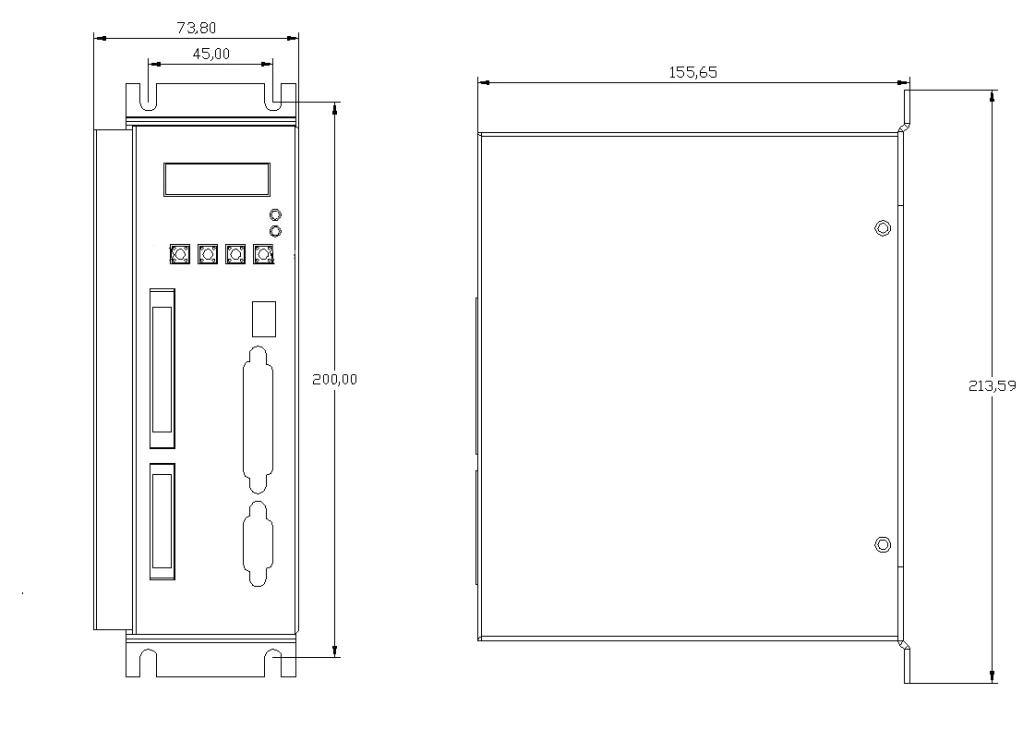
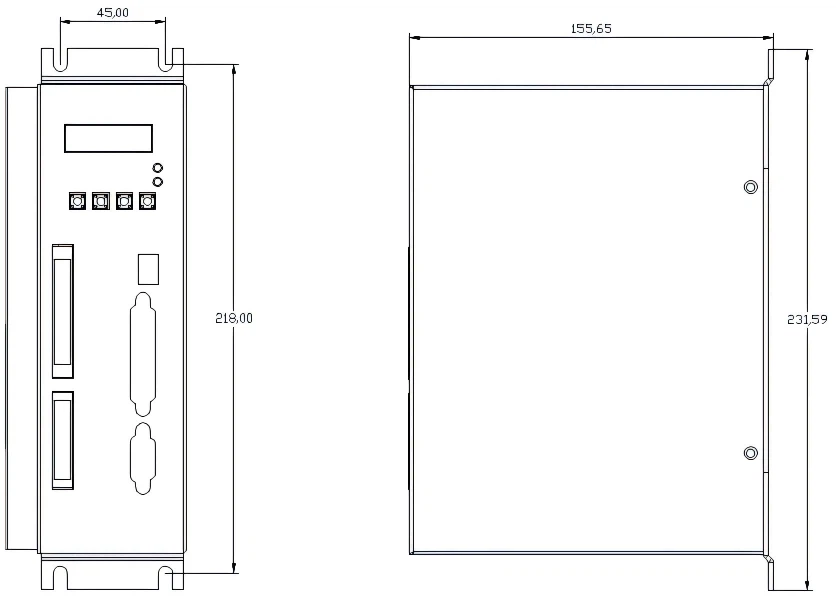
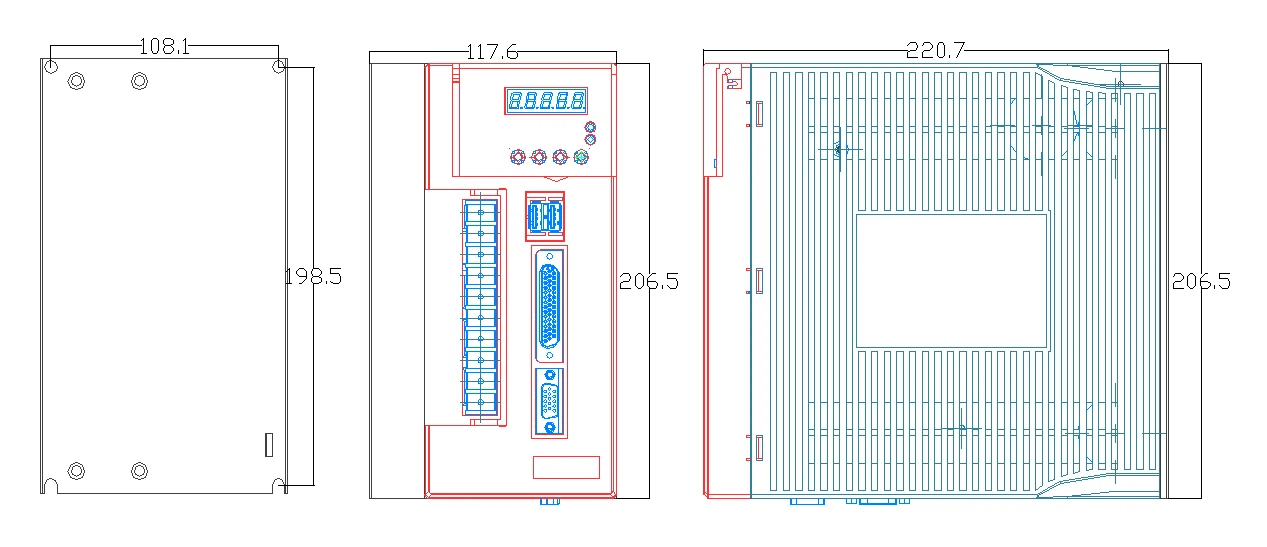
T3a Servo Drive Dimensions and Installation Reference
Control cabinet planning requires attention to the drive's external dimensions, mounting points, wiring access and ventilation space. The following drawings provide dimensional references for different T3a models. Please use the technical drawing corresponding to the actual model when preparing the cabinet layout.

How to Select a Suitable Servo Drive
Selecting a drive requires more than matching the rated power of a motor. Machine builders should evaluate the mechanical load, movement profile, power supply, feedback device and communication requirements together. A well-matched system can reduce unnecessary commissioning adjustments and help the equipment operate according to its intended process.
1. Motor Power and Load
Confirm the motor's rated power, rated current, rated speed and torque requirements. Consider the actual machine load, acceleration demand, friction and possible load changes rather than selecting a drive by power alone.
2. Power Supply
Check whether the equipment uses a 220V or 380V AC supply and confirm the required phase configuration. The drive input specification must match the available electrical supply.
3. Control Method
Determine whether the machine requires position, speed or torque control. Some applications may combine different control modes, so the selected model should support the required operating method.
4. Feedback Compatibility
The motor encoder or feedback device must be compatible with the drive. Confirm the feedback type, resolution, wiring and supported interface before purchasing a complete servo system.
5. Communication Interface
Review the PLC or motion controller interface requirements. Check the supported protocol, communication wiring, command format and available functions for the specific drive series.
6. Installation Conditions
Review the control cabinet space, mounting dimensions, ambient temperature, ventilation and cable routing. These details should be considered during the equipment design stage.
PLC Integration and Motion Control Coordination
In an automated machine, the PLC or motion controller usually manages the production sequence, while the servo drive controls the motor according to the received commands and feedback signals. The communication method depends on the selected hardware and system architecture. Before integrating a drive into an existing production line, engineers should confirm both the electrical interface and the control logic.
Typical Integration Process
Step 1: Controller Command
The PLC or motion controller sends a target command, such as a position reference, speed command or torque instruction, through the supported control interface.
Step 2: Drive Signal Processing
The drive processes the command according to its control mode and generates the electrical output required to operate the connected servo motor.
Step 3: Motor Feedback
The motor feedback device provides position or speed information. The drive uses the supported feedback signal to monitor motor movement and adjust its output.
Step 4: Status and Fault Monitoring
Depending on the control interface, operating status and fault information can be used by the controller for sequence management, alarms and troubleshooting.
For projects involving Modbus, CANopen, EtherCAT or pulse command control, the supported interface and communication functions should be checked against the selected model. If the equipment already has a PLC program, providing the controller brand, model and communication requirements can help the engineering team assess compatibility before ordering.
Installation, Commissioning and Maintenance Considerations
Correct installation and commissioning are important for achieving stable motion performance. The drive should be installed according to its technical documentation and the electrical design of the machine. A systematic commissioning process also makes it easier to identify wiring errors, parameter mismatches and mechanical problems.
Electrical Installation
- Verify the input voltage and wiring configuration.
- Separate power cables from sensitive signal cables where required.
- Follow the recommended grounding and shielding practices.
- Check terminal connections before energizing the system.
Initial Commissioning
- Confirm the motor and drive model compatibility.
- Set motor-related parameters according to the documentation.
- Check command direction and feedback response.
- Test the machine at a suitable operating speed before production.
Routine Inspection
- Keep the control cabinet clean and adequately ventilated.
- Inspect cable connections and terminal conditions.
- Review fault records and unusual operating conditions.
- Follow the maintenance intervals specified by the equipment supplier.
Before vs. After: Upgrading the Motion Control System
When a machine uses an older or less suitable motion control arrangement, positioning consistency, response to changing commands and coordination between axes may become difficult to manage. A properly selected servo system can provide a more structured approach to motor control. Actual improvement depends on the machine design, mechanical condition, controller and commissioning settings.
Traditional Motion Control
• Limited positioning flexibility
• Less coordinated movement
• More manual adjustment during setup
• Difficulties when adapting to changing process requirements
Servo-Based Motion Control
• Position, speed and torque control options
• Feedback-based motor control
• Flexible integration with suitable controllers
• More systematic parameter configuration and fault monitoring
About Tonghang E-Drive
Zhejiang (Hangzhou) Tonghang E-Drive Technology Co., Ltd. was founded in 2017 and is a national high-tech enterprise integrating research and development, production, sales and after-sales service. The company focuses on electric drive and motion control technology, with product categories covering servo drives, servo motors, high speed door servo motor and controller systems, and integrated servo motor and drive products.

Manufacturing and Engineering Capabilities
Tonghang operates a 5,000㎡ clean workshop equipped with automated machinery and precision testing instruments. Its manufacturing environment supports production processes and product inspection, while the engineering team works with customers on product selection and technical requirements.
The company's development history includes the introduction of the T3L and S3a series in 2018, T3a, T3G and T3M series in 2019, T5a and S5a series in 2020, bus servo products including M2, M3 and CANopen series in 2021, and the T3D single-board series in 2023.
Support Throughout the Project
Pre-Sales Engineering Support
The engineering team provides consultation during equipment planning to help customers review motion requirements, product selection and system performance expectations.
Technical Coordination
Product drawings, performance data and specification recommendations can be discussed according to project requirements and customer feedback.
After-Sales Assistance
The company provides technical support for customer inquiries and helps address product or application questions during equipment operation.
For more information about the company, manufacturing environment and development history, visit the Tonghang E-Drive About Us page.
FAQ
1. How do I choose the correct servo drive power rating?
Start with the motor's rated power and current, then evaluate the machine's load torque, acceleration and deceleration requirements, operating cycle and potential overload conditions. The drive and motor should be selected as a compatible pair. For an accurate recommendation, provide the motor datasheet and machine operating details.
2. Can a servo drive work with an existing PLC?
Compatibility depends on the PLC model and the communication or command interface supported by the selected drive. Check whether the system uses pulse commands, RS485, Modbus, CANopen, EtherCAT or another supported interface. The wiring, protocol settings and controller configuration should be reviewed before integration.
3. Are all communication protocols available on every model?
Not necessarily. Communication functions vary by product series and model. Customers should confirm the required protocol, interface type and related functions against the corresponding technical documentation before placing an order.
4. What information should I provide when requesting a quotation?
Useful information includes the required power rating, input voltage, motor model, encoder type, control mode, communication protocol, application equipment and estimated order quantity. If replacing an existing drive, providing its model number and wiring or parameter information can also help with compatibility evaluation.
5. Can Tonghang provide technical assistance before ordering?
Yes. Tonghang provides pre-sales engineering consultation to help review application requirements, product selection and technical specifications. Customers can share their equipment details and expected operating conditions for further discussion.
6. What should be checked before installing a new drive?
Check the input power supply, motor compatibility, feedback connection, control interface, mounting dimensions, grounding and ventilation requirements. Follow the installation and commissioning instructions for the selected model, and complete initial testing before running the equipment at normal production conditions.
Discuss Your Factory Automation Requirements
Looking for a suitable drive configuration for new machinery or an existing production line? Share your motor specifications, control requirements and application details with Tonghang E-Drive. Our team can help review the technical requirements and recommend a suitable product series for your project.
Send InquiryHot Tags: servo drive for factory automation, China servo drive for factory automation manufacturers, suppliers, factory, Digital Servo Drive, Electric Servo Motors and Drives, CNC Servo Drive, AC Servo Amplifier, 3 Phase Servo Motor Driver, Compact Servo Drives


