

Introduction
Automation is a field with a primary focus on industrial applications, where servo motors play a pivotal role-typically serving as the driving components in systems requiring precise control over speed or position. Designers of automated equipment frequently face the challenge of selecting the appropriate motor; given the multitude of models and parameters offered by suppliers, the selection process can be confusing for newcomers. This article shares practical insights drawn from the author's professional experience to assist readers in navigating this process.
Application Scenarios
Motors used in automation control systems include servo motors, stepper motors, and variable-frequency (inverter-driven) motors. Servo motors are typically chosen when a specific component requires a relatively high degree of precision regarding speed or positional control.
Variable-frequency drive (VFD) systems control motor speed by altering the input frequency. This method is generally employed for speed regulation purposes only.
A comparison between servo motors and stepper motors reveals the following distinctions:
a) Servo motors utilize closed-loop control systems, whereas stepper motors typically operate in an open-loop mode.
b) Servo motors employ rotary encoders to measure position with high precision, whereas stepper motors rely on discrete step angles. In typical product offerings, the positional accuracy of a servo motor can be orders of magnitude higher than that of a stepper motor.
c) The control interfaces for both types of motors can be similar (e.g., utilizing pulse and direction signals).
Power Supply
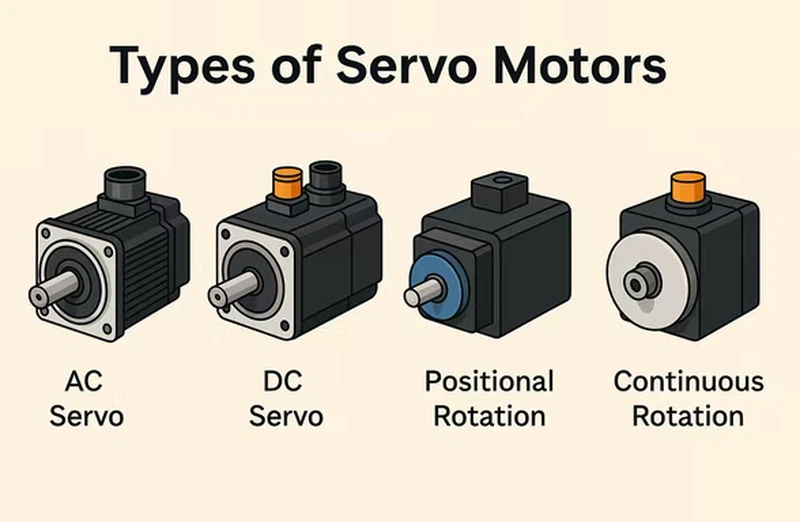
Servo motors are classified as either AC servo motors or DC servo motors, depending on their power source. The selection process is typically straightforward: since standard automated equipment is usually powered by a 380V industrial supply or a 220V mains supply, one should select a servo motor that is directly compatible with the available power source to avoid the need for power conversion. Mobile systems-such as shuttle platforms in automated warehouses-often utilize onboard DC power and, consequently, typically employ DC servo motors.
Holding Brakes
When designing a mechanism, it is essential to consider whether-and under what circumstances (e.g., during a power outage or system shutdown)-the load might rotate or descend due to gravity. If there is a potential for such rotation or movement, one should select a servo motor equipped with a holding brake.
Sizing Calculations
Based on the previously determined dimensions, establish the requirements for execution position and speed, and then select the transmission mechanism. At this stage, you can select the appropriate servo system and gearbox.
Key parameters to consider during the sizing process include:
Power and Speed
Calculate the required motor power and speed based on the type of mechanism and the load's speed requirements. Typically, you can also select a gearbox ratio to match the speed characteristics of the chosen motor.
In practice, for horizontal motion, the friction coefficient and aerodynamic loads acting on the transmission mechanism are often uncertain; therefore, the formula P = T * N / 9549 cannot be used to determine the required torque with absolute precision. In reality, the peak power required from the servo motor often occurs during acceleration and deceleration phases. Using the formula T = F * R = m * a * R allows for a reasonable estimation of the required motor torque and gearbox ratio, where *m* represents the load mass, *a* represents the load acceleration, and *R* represents the load's rotational radius.
Additional considerations include:
a) Motor power margin.
b) Transmission mechanism efficiency.
c) Whether the input and output torque ratings of the gearbox meet the requirements with a sufficient safety factor.
d) Potential future requirements for increased speed.
In certain traditional industries-such as crane manufacturing, where acceleration requirements are not particularly stringent-designers often utilize empirical formulas for sizing purposes.
Note: For loads involving vertical movement, the acceleration due to gravity must be included in the calculations.
Inertia Matching
To achieve high-precision control of a load, it is essential to consider whether the motor's inertia is appropriately matched to the system's inertia.
There is no single definitive explanation available online regarding exactly why inertia matching is necessary. A common practical rule of thumb is to ensure that the ratio of the reflected system inertia (at the motor shaft) to the motor's own inertia does not exceed 10:1 (though this specific limit may vary by manufacturer-e.g., Siemens). A lower ratio generally results in greater control stability but necessitates a larger motor, thereby reducing cost-effectiveness. For detailed calculation methodologies, please consult university-level theoretical resources on mechanical mechanisms.
Precision Requirements
After accounting for the gearbox reduction ratio and the transmission mechanism, verify that the motor's control accuracy meets the load's specific requirements. Be sure to consider the backlash (clearance) within the gearbox, as well as any play or slack present in the transmission components.
Control Compatibility
Coordinate with the electrical design engineer regarding the compatibility of control interfaces-specifically, whether the communication method of the servo controller matches that of the PLC and the encoder type, and whether the encoder data needs to be exposed.